Housing is one of Nigeria’s most urgent development priorities, but the country’s housing challenge is not simply a shortage of buildings.
It is a challenge of trust, land, finance, delivery, infrastructure, documentation and scale.
For decades, many housing initiatives have struggled because they were treated as isolated property transactions. A developer finds land, markets units, collects deposits and attempts construction. But in a market affected by title uncertainty, rising construction costs, weak mortgage penetration, informal development practices and inconsistent project governance, that model often leaves buyers and investors exposed.
Fatherland Smart Cities is seeking to change the structure of the housing conversation.
Rather than present itself only as a developer, Fatherland is being positioned as a housing and urban development platform within the NCDF Group ecosystem. Its model connects public-private partnerships, government-backed land access, diaspora participation, institutional capital and standardised development execution.
That platform approach is important because Nigeria’s housing market requires scale, but scale cannot be achieved without institutional structure.
Track Record as Strategic Currency
In infrastructure and housing, credibility is earned through execution.
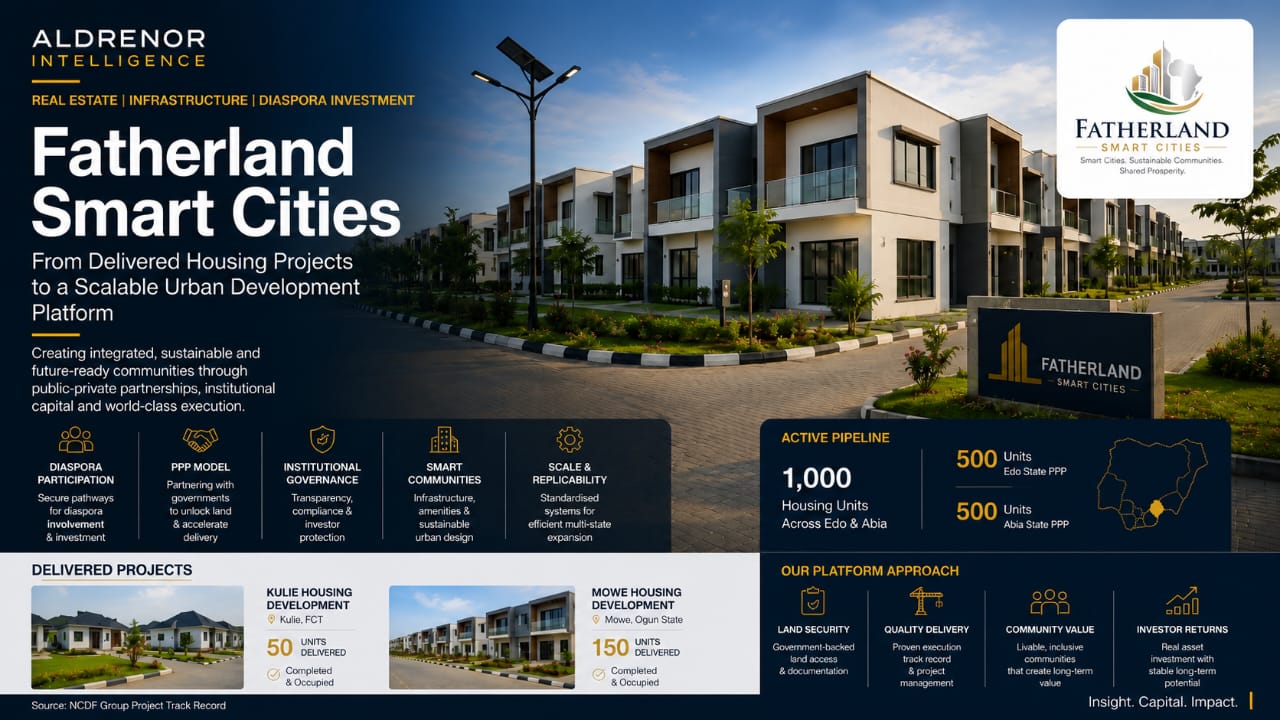
NCDF Group’s realised track record provides an important foundation for Fatherland Smart Cities’ current positioning. The group’s delivered housing projects include the Kuje Housing Development in the Federal Capital Territory, where 50 residential units were completed, and the Mowe Housing Development in Ogun State, where 150 residential units were delivered and occupied.
These completed projects matter because they demonstrate that the institution’s housing thesis is not merely conceptual. It has a history of translating capital, land, planning and construction into completed assets.
For investors, this is essential. In real estate development, a proposal is not enough. Execution history matters. Delivery discipline matters. Occupancy matters. Project governance matters. The ability to move from promise to completed units is the difference between speculation and infrastructure development.
Fatherland Smart Cities builds on that execution foundation.
From Project Delivery to Platform Delivery
The next stage of Fatherland’s development is not simply to repeat isolated housing projects. The larger opportunity is to transform delivered experience into a repeatable housing delivery system.
This is where the platform model becomes strategically important.
A project is limited by its site. A platform is expandable across locations.
A project depends heavily on one development cycle. A platform can manage multiple cycles.
A project may be funded as a single transaction. A platform can attract structured capital participation.
A project delivers units. A platform can deliver housing, infrastructure, community planning and long-term asset value.
Fatherland’s current model is built around public-private partnerships, standardised execution systems and scalable multi-state participation. It positions housing as infrastructure rather than as a one-off property sale.
That shift has major implications for governments, diaspora buyers, local communities and institutional investors.
The PPP Advantage
Land is one of the most significant risks in Nigerian real estate. Disputes over title, acquisition, encumbrance and documentation can delay or destroy development projects. Fatherland’s PPP model is designed to reduce this risk by aligning projects with government-backed land access and public-sector priorities.
In this model, government contributes land, policy alignment and development support. Investor capital supports project financing. The platform provides planning, construction delivery, sales coordination and execution oversight.
This creates a more aligned structure than purely speculative private development.
For state governments, PPP housing platforms can help accelerate housing delivery without requiring the public sector to carry the full development burden. For investors, government-backed land access can reduce one of the most difficult early-stage risks. For buyers, structured development oversight can improve confidence. For communities, housing delivery can be linked to infrastructure, utilities and economic participation.
Fatherland’s active project pipeline reflects this approach.
The platform is currently associated with a 1,000-unit multi-state housing investment structure across Edo and Abia. The Edo State PPP is positioned around 500 housing units across three locations, supporting distributed development and phased delivery. The Abia State PPP is also positioned around 500 housing units, using a cluster-based development model that can support centralised execution, infrastructure delivery and cost efficiency.
Together, these projects represent more than unit count. They show a dual model: geographic diversification through distributed development and operational efficiency through clustered delivery.
Diaspora Housing and the Trust Problem
One of Fatherland Smart Cities’ most important market opportunities is diaspora housing.
Nigerians in the diaspora have long sought secure pathways into home ownership and real asset investment at home. Yet many have faced familiar risks: informal land transactions, weak documentation, unverified developers, abandoned sites, opaque payment structures and lack of reliable project monitoring.
This has created a trust deficit.
Fatherland’s platform approach responds directly to that deficit by creating a more structured route to property participation. Verified land access, PPP alignment, phased execution, institutional governance, reporting discipline and platform-level oversight can help convert diaspora demand into secure housing delivery.
This is not simply about selling houses to Nigerians abroad. It is about converting diaspora capital from informal remittance flows into productive real assets.
That distinction matters.
Diaspora capital is often used for consumption, family support and emergency needs. These flows are valuable, but they do not always create permanent assets. Housing provides one of the clearest pathways for converting diaspora resources into long-term wealth, family security and community development.
Fatherland’s strategic opportunity is to make that pathway more credible.
Smart Communities, Not Just Housing Estates
The use of the phrase “Smart Cities” should not be reduced to technology branding.
At its best, smart urban development means better planning, better infrastructure, better utilities, better community systems, better environmental design and better economic integration. Housing units alone do not create livable communities. Roads, power, water, security, health access, digital connectivity, schools, commerce and governance systems all matter.
Fatherland’s positioning points toward this broader agenda.
The platform’s smart community development model includes road and utility infrastructure, energy and sustainability systems, community planning, amenities and future-ready urban design. This is critical because Nigeria does not only need more houses. It needs more organised settlements capable of supporting households, livelihoods and long-term asset value.
Housing should therefore be seen as economic infrastructure.
A well-planned housing platform creates jobs across construction value chains, supports local materials markets, expands household wealth, attracts diaspora participation, improves urban organisation and strengthens state-level development.
Why Fatherland Matters Now
Nigeria’s housing challenge is large, but the opportunity is equally significant. Rapid urbanisation, population growth, diaspora demand and affordability pressures continue to expand the need for credible housing platforms.
The market does not need more informal promises. It needs bankable structures, transparent governance and disciplined execution.
Fatherland Smart Cities enters that space with three strategic assets.
First, it is connected to a wider institutional ecosystem through NCDF Group.
Second, it is supported by a track record of delivered housing projects.
Third, it is building a scalable PPP-led platform across multiple states.
This combination gives Fatherland the potential to become more than a real estate developer. It can become a housing infrastructure platform.
For governments, it offers a route to accelerate housing delivery.
For diaspora participants, it offers a more secure pathway to property ownership.
For investors, it offers exposure to real asset-backed development.
For communities, it offers the possibility of planned, service-linked urban growth.
For NCDF Group, it provides a physical development engine within the wider capital and execution architecture.
The central question for Nigeria’s housing future is no longer whether demand exists. Demand is clear. The real question is who can organise land, capital, execution and trust at scale.
Fatherland Smart Cities’ answer is platform delivery.
If it can maintain governance discipline, execution quality and transparent reporting, it could help move Nigeria’s housing market from fragmented real estate activity toward institutionally structured urban development.